Showing posts with label me being a self-righteous git. Show all posts

Tuesday, February 23, 2016

"When the polls go down, the vileness goes up."

It’s been a while (over a year, in fact) since I’ve added anything to this so-called blog, but this morning I watched the video linked below and felt the need to respond.


The simple response is this: “Yes! This! What Adam Bandt said!”

A more considered response is this: I have a grudging respect for John Howard, not because I agreed with his policies or cheered when he led us into a complex, deadly and endless war in the Middle East, but because of a political shrewdness that allowed him to hold the top job for eleven years. The very best example of this shrewdness came during the “children overboard" affair of October, 2001, when Peter Reith and John Howard, in the lead-up to a tight federal election, alleged that asylum seekers on boats had threatened to throw their children overboard in order to secure safe passage to Australia. This very quickly spiralled into reports that the asylum seekers had done precisely that. However, when it emerged that this was untrue, John Howard showed what a clever politician he really was by saying, “I never said that those people threw their children overboard – I simply asked if we as Australians would want to welcome the kinds of people who would throw their kids overboard.” Back covered, bullets dodged, election victory secured.

From Fairfax Media.
And now Peter Dutton, a man with all the political acumen, nous and dexterity of a fifth-grade debating alternate, suggests that some babies and children in our camps on Manus Island and Nauru might follow Baby Asha’s case and turn to self-harm in an effort to get to Australia via the world-class socialised health system that others in his party are concurrently trying to weaken. But not content with suggesting the absurd, he went on to suggest the outrageous and despicable – that Baby Asha’s mother might have deliberately thrown boiling water on her baby in order to circumvent the harsh no-settlement-for-boat-people policy shamefully adopted by both major parties. Refugee advocates have told us that the mother was repeatedly asked whether she had been "coached" by advocates to burn Asha. 

There are two things I need to say about this. First, to even make such a suggestion is disgraceful, even with the convenient Howard-Reith “I was speaking in hypotheticals” caveat that is certain to come. All I can hope is that when Dutton’s statement is related back to Asha’s mother, some of the disgusting innuendo is lost in translation, just for her sake. Second, if it were to emerge that parents were harming their kids in order to get them into Australian hospitals, as unlikely as that might be, I would hope that rather than allowing that to be seen as some kind of xenophobic reflection on their worth as people and parents, we might recognise it as a symptom of the absolute desperation of these men, women, children and babies held in prison for a period without an end in sight. But to be completely clear, I would be very surprised if this turned out to be the case.

It was infuriating to hear Dutton say yesterday that refugee advocates have used the Baby Asha case to “raise their own media profile, which is disgraceful”. No, what is disgraceful is finding a way to turn this thing around to reflect badly on the good and kind people who are standing up in representation of voiceless people. And speaking of voiceless, it was revealed three nights ago that Asha's mother was not allowed to make or receive phone calls or meet advocates, on the orders of Serco staff. To put it another way, the distraught and frightened parent of a burned infant was treated like a common criminal and denied basic rights of communication, not by police or correctional officers, but by private contractors hired by our government. Just let that sink in.

Finally, note the timing – all this is happening just in time for what is sure to be a closely-fought election campaign. As Adam Bandt said, with the L/NP brand of politics, when the polls go down, the vileness goes up.

Saturday, June 7, 2014

Why I'm not embarrassed to read YA

So then there’s this, an article by Ruth Graham on Slate titled Against YA, with this tagline: Read whatever you want. But you should feel embarrassed when what you’re reading was written for children.

I won’t lay out every argument Graham makes – you can go read it for yourself – but suffice to say that the tagline is exactly representative of the rather superior position she takes.

In her article, Graham makes many points with which I take issue, but I’m going to focus the convergent beam of my disagreement upon a couple of her more general points, precisely because that’s what they are – extraordinarily generalised.

As far as I can tell, all books written for adults are about people having affairs. Or people being missionaries. Or about surviving cancer, then not surviving cancer, then saying goodbye to the rest of your family as they watch you fail to survive cancer. Of course this is an absurd claim, and to make such a claim is to make it abundantly clear that I’ve only ever read books about affairs, missionaries and people failing to survive cancer. 

This from Graham’s article:
Most importantly, [YA] books consistently indulge in the kind of endings that teenagers want to see, but which adult readers ought to reject as far too simple. YA endings are uniformly satisfying, whether that satisfaction comes through weeping or cheering. These endings are emblematic of the fact that the emotional and moral ambiguity of adult fiction—of the real world—is nowhere in evidence in YA fiction. These endings are for readers who prefer things to be wrapped up neatly, our heroes married or dead or happily grasping hands, looking to the future. But wanting endings like this is no more ambitious than only wanting to read books with 'likeable' protagonists.

This is a little like saying that all country music is simplistic and sentimental. One can make a strong case, using myriad examples both prominent and obscure, for precisely this assertion. Except it’s not true. And it can be demonstrated to be untrue by anyone with a more than passing familiarity with country music. 

Okay, I think that’s enough of that. That point needn’t be laboured, except to quote Graham from later in her piece:
I do not begrudge young adults themselves their renaissance of fiction. I want teenagers and ambitious pre-teens to have as many wonderful books to read as possible, including books about their own lives.
To acknowledge the breadth of variety within YA in one breath, but to then generalise so bluntly in the next feels lazy at worse, dishonest at worst. But to then double down by characterising John Green’s juggernaut The Fault In Our Stars as 'a nicely written book for 13-year-olds' as she does is at once arguably true and unarguably narrow. Add to this her suggestion that YA is all about 'escapism, instant gratification and nostalgia' (apparently we “defenders” of YA fiction “admit” this) followed by this quoted line from Jen Doll: 'At its heart, YA aims to be pleasurable'; and you have a wilfully restrictive view of what is not so much a genre as an entire market. Restrictive and, in many, many cases, downright wrong. Demonstrably so.

But even that’s not my greater concern. My greater concern is touched on ever so slightly by Graham, when she opines: 'There’s of course no shame in writing about teenagers; think Shakespeare or the Brontë sisters or Megan Abbott.'

I’d go considerably further than that. I would argue that a great many of the books and stories now considered classical mainstays would, if published today, find themselves on display in the young adult section of our bookstores. Wuthering Heights, Pride and Prejudice, Great Expectations, Nicholas Nickelby, Oliver TwistTom Sawyer and Huckleberry Finn, and Tess of the d'Urbervilles are all about young people finding their way in the adult world. Finding a place of belonging, if you will, or an identity beyond that of their childhood. Romeo and Juliet, published and premiered today, would be YA. Even the greatest of Shakespeare’s plays, Hamlet, calmly and systematically checks off many of the tropes often associated with the YA 'genre'. We can list them: 
  • Hamlet is an “emo”; 
  • his father is dead; 
  • his mother is in a bizarre rebound relationship; 
  • his best friend is so cool that it hurts; 
  • his girlfriend is so crazy she ends up face-down in a pond; 
  • he’s suffering from suicidal ideation; 
  • he’s talking to himself a lot
  • and in the end, pretty much everyone dies.

So Graham is right – there is no shame in writing about teenagers. As I hope I’ve pointed out, there is a long history of doing just that to be found amongst the work of some fairly handy writers. But even in making that point, I think a greater point is at risk of being missed: that there is no shame in writing as a teenager. And I don't mean teenagers who write, necessarily, but adults who write from the teenaged part of their experience.

You see, while I can’t speak for any one my YA-writing colleagues, writing as a young adult is what I see myself doing. All the time. Finding those stories that resonate so strongly with the fourteen-year-old James that the forty-five-year-old James has to tell them.

If you'll indulge me, let me offer a tiny slice of my own history. I grew up in a missionary family, and every two or three years our parents would announce that we were moving. Friends, relatives, everyone was going to be left behind while we headed off to do our Christian duty. As a result of this, I got to grow up in some fairly remarkable places. But the down-side was a crippled sense of identity. A kind of arrested social development. An itch between my emotional shoulder-blades that even now I sometimes struggle to reach. The only way I’ve found to scratch that itch with any kind of satisfaction is through my writing, so as a result, that 'trauma' (a dramatic word, I know, but it’s the best I’ve got) has also been one of the great blessings of my life. Without it, I wouldn’t be doing this, right now. Writing for a living. And I love this. 

Graham, in her Slate piece, says: 'I have no urge to go back and re-read [the books I read as a child], but those books helped turn me into the reader I am today. It’s just that today, I am a different reader.'

In response to this, I would say the following: I’m happy for you. I’m happy that the books you read as a young person set you up so neatly for all those 'real' books you now enjoy. But for every 'literary' reader such as yourself, there’s at least one of me. You see, I couldn’t give a tinker’s cuss about someone’s affair, or the search for the code to the identity of the Illuminati, or a glass cathedral floating down a river, or Thomas Cromwell’s rise to power. I'm not saying you shouldn't either – if you want to read about an Indian sweet-maker defying the odds to become a successful businessman, I say fill yer boots! But no, I’m much more interested in a story like that of Arnold in The Absolutely True Diary of a Part-Time Indian by Sherman Alexie. Because I’m a native American kid from a reservation in Washington State? Of course not. Because I was – and in some ways remain – a kid who, like Arnold, is trying to find my place in the world.


And while I thank you for your concern, I refuse to be embarrassed by that.

Thursday, February 27, 2014

"Hi Pot, this is Kettle" - Miranda Devine screams hypocrisy on behalf of the right

This is the original Devine piece in question, from The Daily Telegraph...

_________________________________________
And this is my response...

The temptation with anything written by Miranda Devine is to immediately dismiss it as shrill and unreasoned, based on a long and established history of writing shrill, hysterical op-ed pieces for Fairfax, and now Murdoch. In any other forum she would be labeled a troll, and the best evidence of this is in the dreadful tone of the majority those commenting on her blog. Perhaps they are trolls themselves, but the tone is so uniformly dreadful that one has to assume these people actually think this way.

But, despite this temptation to dismiss Devine’s latest blog post, I will attempt to address a couple of the points she makes.

 First, I find that the use of the word hypocrite is fraught, not least of all because it tends to attract a “tit for tat” series of accusations. “That was only one time, but it wasn’t as bad as when someone else did some other much worse thing.” “Yeah, but what about when this guy said that thing about that other guy?” ”Sure, but remember when you called me this after I said that?”And so on, ad nauseum. Achieving nothing.

But, that said, let’s do some of that anyway, ergo… Devine railing against the Abbott effigy-decapitators and the Abbott-haters on Facebook. Any reasonable person will argue that that kind of extreme protest is unhelpful at best, utterly destructive at worst. As Australians, I would hope we’re collectively better than that. And someone needs to explain this to Andrew Bolt, for instance, or to Larry Pickering, who is adored by a small fringe on the right, but otherwise ignored and dismissed as the rabid loon that he is by pretty much every reasonable Australian. See what I mean? Both sides of the debate can play the indignation game, which leads the concept of hypocrisy into an Inception-esque meta spiral of dreams within dreams, hypocrisies within hypocrisies. So it’s a potentially endless exercise in accusation and counter-accusation.

What is equally pointless as an exercise, be it academic or practical, is to waste time pointing fingers at the previous government and accusing them of causing this mess. The culpability of Labor/Greens in contributing to the failure of Howard’s border policies is undeniable. Lives were lost. Many lives. Contrary to what many on the Right would have us believe, no one was happy about this. No one was crying “crocodile tears”- to suggest such a thing is despicable (if not surprising) on Devine’s part. So yes, under Howard the boats had stopped. The camps were largely empty. However, what this admission doesn’t address is the methods the Howard government employed to develop, enforce and maintain those policies, aided in part by Peter Reith’s proven and willful omission of truth around the children overboard affair (for instance) and the rising tone of public outrage which followed (and ultimately ensured an unlikely election win). But even Howard and Reith in their worst moments were nothing compared with Abbott and Morrison, for reasons I’ll attempt to explore momentarily.

The reason this endless blame game is so pointless is because it doesn’t fix the problem we are faced with now. Right now. Not just locally, but internationally. Not just in terms of actual, skin-and-bone and mental human suffering, but in terms of our international reputation (as if that matters one bit when compared with real personal suffering.) Naval vessels wandering into Indonesian waters up to six times in a month, turning boats around against the wishes of our peaceful neighbours, and a growing feeling overseas that Australians are, well, hypocrites (to quote a teacher here in Hong Kong this very week, who marvelled at our ostensibly anti-immigration stance considering we are, if nothing else, a nation of immigrants.)

Again, none of this is fixed by tossing around accusations of hypocrisy. And none of this is fixed by trying to deny that with the possible exception of the impossibly idealistic Greens, leading into the last two elections both sides of our political scene were entirely willing to exploit a growing xenophobia by endlessly chanting the “stop the boats” mantra.

And certainly none of this is being fixed by Scott Morrison, who is, in my view, approximately 180 degrees from the “competent, methodical” operator that Devine would have us believe he is. Rather, I see him as completely out of his depth. None of it is being fixed by using sneering, snarky descriptors like “crocodile tears” when the concern being shown by the “hypocritical” left. And in addition to not being fixed, it is being exacerbated by Morrison’s steely refusal to tell us anything. When he does tell us something, it turns out to be half-cocked, or just plain wrong, even a barefaced lie. The man who died last week was not outside the compound (and therefore outside of his department’s care) as Morrison plainly told us, but very much inside. And whilst he was not murdered by Morrison (an admittedly inflammatory and mischievous turn of phrase by Milne) he was almost certainly murdered. He did have his head crushed, possibly his throat cut. It’s hard, even impossible to know specifics, since more than a week  later, an autopsy has not yet been performed on the body which is being guarded by the very people suspected of causing his death. And as we know from history, when there is an information vacuum, suspicion and conjecture emerge to fill it. If there’s nothing to hide, perform the autopsy and tell us what happened. Unlike almost everything else to do with this situation, this bit is actually quite simple. Unless there’s something to hide.

On that point, Devine waxes outraged about Angus Campbell being asked if there is a political cover-up. “How dare he,” she shrieks. Well, personally I think it’s a fair question. We’re not at war, and yet we’re apparently on a war footing, at least where information is concerned. A military commander is overseeing a clearly tense situation, but is gagged by his minister, citing “operational matters”. The situation is not allowed to be covered by the press. Parliamentary questions are restricted to Dorothy Dixers without supplementary follow-ups. Cameras and SD cards are confiscated and wiped at the behest of a private security company, apparently acting on orders from the minister. Translators lose their jobs for simply saying what they saw, ministers storm out of press conferences after ducking and weaving… again, if it’s NOT a political cover-up, tell us what we need and deserve to know, so we can understand the real situation. And don’t tell us that the silence is to keep the people smugglers in the dark – the LNP wouldn’t shut up about boat arrivals pre-September 2013, but now any discussion of the situation amounts to “shipping news”.

Part of the remit of the minister is to take ultimate responsibility for what occurs within his portfolio. But Morrison shows no sign of this. In fact, he only seems interested in blaming the last government for this mess, rather than doing anything about it. We get it – the last government’s policies were costly. Terribly and tragically costly. We get it – Morrison didn’t personally murder anyone, just as Rudd, Gillard and Bob Brown didn’t drown anyone. We get it – it’s a complex situation. But while ever it remains shrouded in this kind of secrecy and we accept it, we end up with the odd bloodstain on our own hands.

Monday, December 17, 2012

Sorry, Felicity Ward, but I think you got it wrong.


So, it seems a few people are getting bent all out of shape over this billboard ad for Who Exclusive, an online shopping site. 


On the face of it, the tagline is hugely offensive to anyone who thinks that women are… you know … equal to men. Without meaning to labour the obvious, it would seem to be suggesting that a woman needs a man to earn the cash required to be kept in the manner to which she is accustomed. Very pre-Cora Downton Abbey, very Betty Draper before she discovers the washing machine's spin cycle. That a woman without her man is nothing.

In response to this ad, comedian Felicity Ward wrote an impassioned and beautifully crafted open letter on her website, later reproduced on Mamamia, titled 'An open letter to the most sexist ad of the year'. I thought the letter's tenor, its craft, its icy fury was first rate. Stand and applaud. It was angry but dignified, much like Julia Gillard hunting Abbotts. 

Except I think Ms Ward got it completely wrong. 180 degrees wrong. As wrong as you can get it.

Putting aside the fact that the people at Who Exclusive will, at this very moment, be doing  a happy-fun-time dance around the boardroom at all this unexpected publicity, I’d like to look at the actual words in the ad. Or more specifically, the punctuation.

Anyone who grew up before texting was the preferred method of conversation knows that punctuation is important. Very important. “Let’s eat Dad!” becomes much less sinister with a simple comma: “Let’s eat, Dad!” Likewise “I love her period”, which should (one hopes) feature a comma betwen the last two words.

Or this: “A woman without her man is nothing.” With the odd comma here and there it becomes: “A woman, without her man, is nothing.” That’s really no better at all. This, however, will probably draw the Mamamia office to its collective feet: “A woman: without her, man is nothing.” To be honest, neither version flies, since equality means… well, being equal. But you see my point.

Returning to the ad in question, those words certainly carry the potential to be offensive. As some Mamamia commenters have pointed out, it’s meant to be ironic, cheeky, provocative. Sure, but “Spend his money wisely” still comes across as hamfisted.

Except that’s not how the tagline is written. The choice of colour for the text is unfortunate, not just because it’s terribly hard to read, but because the first apostrophe is somewhat lost in the colour of the model’s leg. But the second apostrophe is very clear, and changes the entire tone of the sentence. Spins it that full 180 degrees I mentioned earlier. 

“Spend ‘his’ money wisely.” 

In other words, play your cocky partner for the arrogant fool he is and spend the money that he thinks is his. The money that he thinks you need his permission to spend. The money that he’s earning while you, the ever dutiful wife or girlfriend, are at home, watching daytime TV, making pot-roasts, flirting with air-conditioner salesmen, and leaning up against the washing machine. Or worse, playing at having a proper job.

This ad isn’t an attack on feminism. Quite the opposite – this is a huge middle finger to anyone who thinks that a woman needs permission from a man to do anything. And for that we should stand and applaud.

Thursday, October 11, 2012

Which Abbott would we prefer?


Tony Abbott must be either breathtakingly stupid, or deeply dishonest. To illustrate this point, I offer two examples.

First, let's look at his claim that when he spoke of the government “dying of shame” barely a week after the Alan Jones imbruglio, he was not referencing Jones’ deeply offensive comments, but rather using a phrase he has used “seventeen times in the past.”

Perhaps he has. Even so, should we not realistically expect that someone aspiring to the highest office in the land might internally process the ramifications of using such a highly-charged term? That's what his frontal lobe is for. So, either he was too stupid to make that connection in advance, or he knew what he was doing and is now lying about it being inadvertent, a mere slip-up. (It is tempting to offer a third possibility: that he fully meant it, and he intended it to hurt the Prime Minister – to inflict actual emotional pain upon her. But I can’t bring myself to countenance the hideous possibility that someone so cruel could be our next PM, so I’ll try to assume that it’s one of the first two.)

My second example is from yesterday (10 October, 2012) when Mr Abbott produced a power bill sent to him by a disgruntled Perth retiree. Her power bill had doubled! Doubled, I say! He related how she’d almost “had a heart attack” when she saw that her bill had increased from $736 to $1,563. “See, I told you so!” he effectively gloated. “It’s the carbon tax! I told you it would have a crippling impact, and look now! Look now!”

When he tabled the document at Labor's urging, the reason for the woman’s power bill doubling soon became apparent. It was because her power usage had doubled. 

So, once again, which is it? Is Mr Abbott too stupid to notice such a non-trivial error in his reasoning, or has he been caught passing off a deliberately misleading data interpretation?

I suspect it’s the latter – after all, Mr Abbott was a Rhodes Scholar, and they don’t make a habit of handing those out to half-wits. Which would mean that it’s the other option – that he’s happy to say whatever he thinks is politically expedient, and then play the “woops” card when he’s busted.

There’s an additional component to this that should be mentioned. If Tony Abbott’s not stupid – meaning we must therefore assume that he’s being dishonest – we need to draw a clear line to a more troubling conclusion: he thinks that more than fifty percent of Australian voters are breathtakingly stupid. And since we’re talking about someone who wants to lead all Australians after the next election, it's a point that needs to be made, and made often.


Saturday, October 23, 2010

What if I DON'T like it?

I'll say it - I like Facebook. I use it as a professional networking tool as much as a social networking tool. I keep in contact with friends and colleagues, learn of links and connections and industry goss, watch the occasional funny video.

But there is one thing about FB that I find rather irritating. It's the groups with views that might be seen by some as worthy of challenge or further discussion; some examples might be fundamentalist religious groups and prosperity Christians, or conspiracy theorists, or anti-immunisation groups, such as VINE. I find that these groups won't allow you to comment unless you "Like It!". And often we don't like it. But we can't respond. We can't discuss, engage in dialogue, perhaps even learn, unless we agree that we "Like It!", ergo, join the group. And we don't want to do that. Which means that these corners of Facebook remain the sole domain of people who all believe the same thing, and foment those beliefs.

I use the example of VINE, or the Vaccination Information Network. I was in a discussion with a friend about the pros and cons of childhood vaccination, and found my way to VINE, which vehemently opposes vaccination. (Incidentally, this site also likes to provide "evidence" for all manner of conspiracies - the government is gathering data on you so you'll be first against the wall when the revolution comes, the 9/11 attacks were an inside job, drop-bears aren't real, etc etc.)

But the bit that made me sit up straight was VINE's claim that whooping cough is neither "dangerous nor life-threatening". I beg to differ. Almost 300,000 people died globally from pertussis last year, and furthermore, I've personally nursed babies in PICUs who are on life support due to whooping cough. So naturally, I wanted to comment. But I couldn't, unless I joined. I wanted to send a direct message to the person who runs the group. That link was disabled. Meanwhile the regulars on the site are agreeing, agreeing, agreeing, all the while remaining blissfully unaware - or deliberately ignorant - that there is another side to this story.

I'm not saying that FB should shut the site down - I welcome discourse on pretty much anything. But let's at least have the conversation.

Saturday, August 7, 2010

Bogan hospitality


This is where I come on all small-l bleeding-heart liberal lefty, but I can't help it - I have to say something. Last week on The Chaser's "Yes we Canberra", the boys came out to the federal seat of Lindsay, which is next door to the one I live in, and vox-popped some of the Penrith locals, asking whether something should be done to "stop the boats", a phrase which fills me with embarrassment and shame every time Tony Abbott or one of his colleagues uses it. Or the PM, for that matter. And predictably enough, for no other reason than what took place in the editing suite, every single punter they spoke to (each of which was more boganny than the bogannest bogan you've ever encountered) responded exactly as you'd expect: "Yep, we should stop the boats, we don't need any more boat-people, I'll vote for anyone who can stop the effin' boats."

OK, so these punters might have been edited into prominence, but it's also true that they're out there, in most corners of Australian society. Which is why it struck me like a ton of felafel when I was sitting in the Penrith Westfield food court today, and this is what I saw, left to right: Thai, Italian, Japanese, American, Anglo, Mexican, Chinese, Vietnamese, more American, traditional Aussie roast, Lebanese and Turkish, Indian. And a bit more American. And if I was in any of a number of other suburban food courts, I might have even found some African. (What I haven't yet seen in any food court is bush tucker, but maybe one day soon that will come.)

But here's my point: is that what the average Australian wants, for all prospective immigrants of all flavours to come here, leave their family recipe books, then bugger off back "home"? "I don't want any of that foreign muck - I'll just grab a pizza or a doner kebab on the way home from the pub?" Really? If so, say goodbye to me right now, because I'm off to live in Nauru...

Thursday, November 19, 2009

Tolkien the fan-fiction writer

A question, from WikiAnswers: "Where did Tolkien get the story of The Hobbit from?"

Perhaps the person who asked this question had heard that Elvish was in many respects derived from Finnish, and assumed that folklore lent itself to Tolkien's book. And in fact Beowulf is considered to have been something of an influence. There is no such thing as a new idea, really. Heck, Romeo and Juliet is just an earlier rip-off of Titanic.

But to the cynic in me, it seems to me that implicit in the above question is the idea that Tolkien lifted the idea from someone else, in much the same way various writers are now releasing books about vampires and swooning girls, or about wizard academies. (And we shouldn't forget that Stephenie Meyer owes a huge debt to Bram Stoker, and Rowling a similarly large debt to Ursula le Guin.)

Has fan-fiction and wholesale idea-poaching now become such a part of our literary landscape that we assume a great, ground-breaking and iconic work of fiction to have been pinched?

Or am I reading too much into this? I have been known to do this from time to time...

(For Facebook Notes readers: this post is redirected from my 'head vs desk' blog at headvsdesk.blogspot.com)

Monday, November 2, 2009

Names changed to protect the bloody rude.

Today Vicki and I went into Sydney for a meeting. And around lunchtime, we went for a walk. And we went to a book store.

It's a crowded little independent store, full of all the usual kinds of books – literary, trash, non-fiction, travel, cookery, all the usual. And a children's section, which featured a fair range of kids books. In a number of cases, they had four or five copies of books that you might not ordinarily expect to find in multiple numbers.

I've had a lot more joy lately finding my books in stores (even the chains), so I thought it might be safe to look for my titles. I didn't expect to find the entire backlist , just a couple, perhaps. I'm not greedy, but I do think that selling books is somewhat reliant on bookstores stocking them.

There weren't any. Not one. Since this is nothing particularly new, I thought I'd go and talk to the lady who owned the place, and introduce myself. Most booksellers really like it when authors do this. It creates an oft-missing connection between the author and the person who sells the book to the person for whom the book is written. It's not an exercise in ego – it's an exercise in mutual benefit.

'Hi,' I said. 'I'm wondering if you have any copies of Edsel Grizzler, by James Roy?'
'No,' she said, without even looking it up on her computer. 'We don't have it.'
'I see. Have you ever had it...? You sold out, perhaps? Because I wrote it, you see, and I like to check the shelves of local---'
'No, we've never had it. Who published it?'
'UQP.'
'Right. No, I don't have it.'
'Well, it was featured in a double-page spread the Sun Herald a few weeks ago, so it's quite possible that someone who read that piece might come in looking for that specific book.'
'Look,' she said, 'I've only got thirty-eight square metres of space in this store, and I have a lot of books to shelve, but I can't be expected to stock everything that's published.'

At this point, she turned away to cut some ribbon for the books she was gift-wrapping for a rather embarrassed-looking customer. Conversation over.

I couldn't resist a parting shot. 'Well, you seem to have multiple copies of a lot of books by other children's writers, so I'm sure you could find space for one of mine. Thank you.'

The fact is, I always expect to find none of my books in bookshops. It's safer that way – it can avoid real disappointment. And I also assume that the owner has never heard of me, or any of my books. And I'm sad to say, this woman confirmed my assumption. But I have to wonder, would she have been as dismissive – no, let's say it the way it was – rude to a buying customer? I very much doubt it.

An author/illustrator friend had a similar experience himself recently, when he went into another independent store not that far from where we were today, and asked for his book by name (without mentioning that he was the author). While the young shop assistant was looking up the title, her boss asked my friend, 'Are you going to order it in if we don't have it?'

'Probably not today,' my friend said.

At this, the boss turned to his employee and said, 'Stop. Stop looking. If they're not going to order the book, don't search past the title.'

Good to see that customer service is alive and well. I've had better service in the big, impersonal chains, and that's really saying something.

Oh, and by the way, Lady from ******* Bookshop, if you find a pile of books in the entirely wrong section of your store, they're the $200 worth of books we were planning to buy, but ended up putting down. Sorry, couldn't do it.


(If you're reading this via Facebook Notes: this post is redirected from my 'head vs desk' blog.)

Monday, October 19, 2009

The self-righteous git...

...is me, because I'm about to copy and paste something I saw on the Book of Faces...

The Cold Side of the Pillow is colder than normal do to being in the freezer all day.

What the heckfire is a 'colder than normal do'? A winter hairstyle sans beanie?

That is all.
(If you're reading this via Facebook Notes: this post is redirected from my 'head vs desk' blog.)

Friday, October 9, 2009

I think I know how this happened.

Someone legal at Cityrail sent a memo to the Client Safety Office, stating that warning signs should be painted on platforms across the entire Sydney rail network. Perhaps the memo read something like this:

These warning signs should be clear, concise, and leave no margin for ambiguity. We suggest they read "SURFACE MAY BE SLIPPERY WHEN WET".

This memo was cut and pasted into a contract requisition to Signs-R-Us, who sent an order to their stencil-makers, who made dozens of stencils. These were then sent out to station-masters across the network, who dutifully flopped the stencils on the ground, got out their supplied cans of yellow paint, and sprayed the signs, complete with the unnecessary quotation marks. Thus:
I catch a lot of trains. This is going to be a disproportionately huge annoyance for me. Srsly.


(If you're reading this via Facebook Notes: this post is redirected from my 'head vs desk' blog.)

Wednesday, July 29, 2009

So little time...

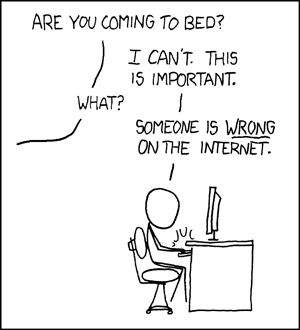
Sometimes I feel like this guy, especially when it comes to punctuation. Just call me Captain Grammatical...


(Thanks to my excellent cousin Clansi, for sending my this via xkcd.com.)

Friday, July 3, 2009

It's happening already.

Part of the argument against parallel importation of books, at least by some parts of the industry, is the 'cultural dilution' of our language. That is to say, some fear that our kids will read Australian books that have been changed to suit American readers, and thereby become American.

Well, folks, it's here. It's happening. I have clear evidence. This morning one of my daughters congratulated me on a quick bit of mental calculation by saying, 'That's some quick math, Dad.'

'Some quick what?'

'Math.'

'Maths! It's maths! With an S at the end!'

(Daughter rolls eyes.) 'Whatever.'

That is all. No, seriously, it's over. I hope someone from the Productivity Commission is reading this.

Saturday, May 16, 2009

The shame of rugby league.

I would love to weigh in on the Matthew Johns furore, but since this blog is linked to my website and therefore occasionally visited by young students, I can't be as direct as I'd like to be. So I'll simply say this...

The trio of Matthew Johns, the second Sharks player, and the young woman involved entered into an arrangement that was consensual, at least at the beginning. That decision was, with the benefit of hindsight (and some might have seen it in foresight as well) clearly a foolish one. They didn't start out doing anything 'wrong' (I've avoided using the word 'immoral', because that's another issue altogether) but a whole world of wrong turned up later in the night.

What alarms me most is the vitriol being spewed in the direction of the girl. Apparently, according to many, many tiny-minded people, and at least one journalist, she got exactly what she was asking for. I don't agree. I suspect it was probably a booze-fueled experiment that became much more than she intended. Questions of morality aside, I don't think that girl signed up for what took place later on in the evening.

Is seven years too long to wait to report something traumatic? Probably. Except she didn't -- she reported it at the time. No charges were laid. No, of course not, because no laws were broken. But that doesn't mean that an abuse of power didn't occur. As twitterer babycakesjase said, 'how much agency does a single19 year old girl have surrounded by a bunch of footy players?'

Should one man take the fall for everyone else involved? Probably not. But I have a message for Matthew Johns: mate, your claim that you 'walked away' when things started going too far does not make you a hero. It does not give you the moral high ground. Quite the contrary. You helped create a situation, but didn't have the guts to speak up when it escalated to a level with which you were uncomfortable. You were a senior team member, and supposed to be a leader.

Some leader.

Friday, May 8, 2009

Pointless


Remind me, how long does it take to start a broom?

Saturday, April 25, 2009

Wha...?

I'm not a perfect parent. I'm nothing like a perfect parent, and I've never claimed to be. But I like to think that I would never allow my child to own a toy M16 semi-automatic rifle. And if, by some freak event, I did allow my child to have such a toy, I feel completely certain that I would never allow that child to take it along to an ANZAC Day parade.

Perhaps these people thought that their young sons were entering into the spirit of the day, what with marching people in uniform, and ex-Army Jeeps, and a Catapult Party with rifles. But then to allow them to run around pretending to fire volleys of bullets into one another was insensitive at best, offensive at worst.

Monday, February 2, 2009

New-clear. NEW-clear!

I just finished watching the excellent Channel4 documentary 1983: The Brink of Apocalypse, which deals with the events of surrounding the Cold War standoff between the USA and the USSR, and how close we came to full-blown nuclear war, seemingly caused in equal measure by paranoia, stupidity and an utter lack of communication.

What leaves me shaking my head is how the producers of such a painstakingly-made documentary can fail to notice that the otherwise excellent narrator, Gina McKee, repeatedly mispronounced the word 'nuclear' as 'nucular'. We've had eight years of this mistake with one George Walker Bush, but he is by all accounts a complete idiot. I'd have expected better from Channel4.

Sunday, January 18, 2009

It's all downhill from here...

It's been some time, but this one I couldn't leave alone. From the Yahoo Answers site, I now cut and paste this gem, from someone called Carly H:

she i give girls dress codes checks everyday?

im an 8th grade teacher and theres alot of girls who wear shirts when they put there hands up there stomach shows or they have there belly showing without there hands up should i crack down on this if your a teacher do u crack down on this stories please
OK, where to start? Maybe at the beginning. 'She I give girls dress codes checks everyday?' It seems that Carly actually believes that when asking a dinner host how she might contribute to the meal, she's actually saying: 'She I bring anything?' or 'What she I bring?' Considering that literacy is partly dependent upon the osmotic effect of actually seeing stuff written down, has this 8th grade teacher (hopefully not of English) ever read a book in her life? Or maybe she's only read from that vast literary canon in which the word 'should' never appears?

So those are my thoughts on the first line. The rest u can work out 4 ur selfs.

PS: Mark Taylor, commentating the cricket, just misused the word 'bought' 3 times in one comment, ie 'The captain only just bought up that man from square leg.' This error is disturbingly common.

Here endeth the rant.

Tuesday, July 8, 2008

The Death of Language

A further instalment in the "me being a self-righteous git" category...

Yesterday, at the reception desk at a hotel in Manly, I heard a tour director for a Canadian Christian group turn to a group of four girls, hand them a key pouch and say: "Jessica, Emily, Amy, Amanda, these is your guys's keys."

I don't even know where to begin.

(And before anyone gets on my case for my spelling of "instalment", the British spelling only has one L in it. And since Australia isn't the 51st American state just yet, and since we are - despite the best efforts of a number of inspired and hard-working people - still under the rule of Queen Elizabeth II of England, I will spell it the British way. So shut up.)

Friday, May 9, 2008

A saltine battery

I've added a new category to my blog today. The "me being a self-righteous git" tag will be reserved for posts that deal with my single greatest literary bug-bear -- those people who stuff the written English language into a sack, tie off the end and proceed to kick thirteen shades of crap out of it, inspired by nothing other than complete ignorance of what certain words look like.

For example, yesterday I saw, on one of those school signs with the slide-in letters, the following message:
GOOD LUCKT OUR DEBATING TEAM

One might argue that the T had slipped slightly to the left, but what happened to the O? And how did it slip, when the whole message was locked behind a quarter-inch-thick sheet of perspex?

And then, this very morning, on a newsblog comment page, someone wrote this gem:

One hour is long enough, little lone eight.

Clearly the creators of these sentences know what said sentences should sound like, but haven't ever seen them written down.

I fear that this won't be the last of these posts.